Choosing the EASY or the HARD Jesus

Sermon: Sunday 7 September 2025

Texts: Luke 14.25-35

Theme: Start of the ‘Season of Creation 2025’ – Peace with Nature

O Saviour Christ, in whose way of love lies the secret of life and the hope of all people. We pray for quiet courage to match this hour; we did not choose to be born or to live in such an age but let its problems challenge us; its discoveries exhilarate us, its injustices anger us; its possibilities inspire us; and its vigour renew us. For your kingdom’s sake. Amen.

I start by thanking Father Paul for the invitation to preach today at St John’s. In fact, it is a return and sort of homecoming for me, because thirty years ago in 1995, in my last year of theological training at St Francis College – I was assigned as a theological student to this very parish and have always since that year carried a soft spot in my heart for this beautiful church and its great congregation. In short – it is good to be back.

Most of you will not know that in Lent last year I was diagnosed with incurable stage 4 prostate cancer. I am happy to state that I’m responding well to good treatment, and the cancer is on hold, but the side effects of the medication have meant I couldn’t continue as a Rector, and I stepped down from full-time ministry last December. Today, in fact, is the first time I have preached since my retirement, and I told Father Paul that I could very well be very, very rusty. I suppose only time will tell, and I apologise in advance if what follows is a jumbled mess. I’m certainly praying hard that God’s voice can be heard in my words.

Last Monday was the 1st of September, the start of the Season of Creation. A season in the Church’s liturgical calendar which the Universal Church has recently set aside for reflecting upon the majesty of the Created Order – the natural world around us. The season lasts just over a month running from the 1st of September until the Feast of St Francis of Assisi on the 4th of October. Father Paul has asked that I particularly refer to the start of this season in my sermon, to set up the remaining Sundays in the season. I’m really happy to do so and will come back to this theme in a moment – but I want to first ask a question for your silent reflection as the Gospel passage this morning contains harsh words uttered from the mouth of Jesus and it begs, for me at least, the following: Do we want to follow the EASY Jesus or the HARD Jesus?

We all know the EASY Jesus – the one who in Matthew’s Gospel says, ‘Come to me, all you that are weary and are carrying heavy burdens, and I will give you rest. Take my yoke upon you and learn from me; for I am gentle and humble in heart, and you will find rest for your souls. For my yoke is easy, and my burden is light.’ This is the Jesus we follow when life is shite, and we are at the end of our rope. Jesus is with us in our mess and says follow me and I will lead you home. I know of late, from personal experience that that’s exactly where I have been and maybe for some of you here this morning that’s the Jesus you need to heed and follow.

But what about our Gospel from Luke this morning where we hear Jesus say, ‘Whoever comes to me and does not hate father and mother, wife and children, brothers and sisters, yes, and even life itself, cannot be my disciple. So therefore, none of you can become my disciple if you do not give up all your possessions.’ For sure, this is the HARD Jesus, the no compromising, no ifs and buts, if you want to be my follower than it’s all or nothing Jesus. And really, is that what we want this morning, not least considering that it’s Father’s Day. And it’s ironic that we seem to be given license to put aside the fifth commandment about honouring our parents in order to hate them in order to follow our Lord. Do we really want the HARD Jesus? Sometimes, if I’m completely honest, the answer to that question is a big NO – give me EASY Jesus any day.

But what do we do with HARD Jesus! A couple of things really. The first is to note that EVERY commentator and scholar that I have read on these words of Jesus says that this is comparison language and not absolute language. It’s not that we have to hate everything including our very lives in order to follow Jesus but that we need to put Jesus number one – above everything else – including the safety of our lives, in order to follow Jesus, to be people of the Way! The second thing follows and that is for us to note the context of Jesus’ words. Large crowds were following. Many had been excited by the miracles of Jesus and the hope of a new life free from Roman occupation, but Jesus was making sure that people truly understood what it meant then and now to be a disciple of the Way. And it is interesting to note how few were left at the end.

The life of faith should be no different than other ventures; discipleship is not a weekend hobby or a vacation destination. It’s a full soul, full body, full mind endeavour that requires renunciation. And surrender. And a reordering of our identities, our priorities, and our proclivities. 

As my good friend Australian theologian Andrew McGowan writes in his recent commentary on this passage:

An implication of Jesus’ address to the crowds is that not all of them (or us) will decide they really can build this tower or fight this battle. Jesus thus refuses the possibility that he or his message can be something just incremental, a form of “spirituality” that can be added to enhance a life that remains bent on other priorities, whether personal, familial, or national. Jesus will not be harnessed to any agenda to make us more efficient consumers, or leaders, or even family members, independently of him. Following him means giving all that up.

Sometimes I understand fully that my life is very comfortable thank you, in spite of my cancer diagnosis, and it really is the HARD Jesus way that I need to be reminded of. By dint of our baptism, we are all members of the body of Christ, we believe in God, and I hope that we trust that following in the Way of Jesus is the only life worth living. At times it is the EASY Jesus we hear and at times it is like today, the HARD Jesus. But, regardless of which Jesus we choose, both require us to follow.

So, let’s finally get to the Season of Creation. At last, some of you are thinking. But let me state that we need to be reminded all the time that our faith is not abstract but something we live as followers of our Lord and Saviour. Father Paul reminded you last week, for those here, that we Anglicans have adopted five marks of Mission. I think he described them as pillars and that’s good. They are five markers that describe our individual and collective action as followers of the WAY!

To remind you they are: To proclaim the Good News of the Kingdom, To teach, baptise and nurture new believers, To respond to human need by loving service, To transform unjust structures of society, to challenge violence of every kind and pursue peace and reconciliation, and To strive to safeguard the integrity of creation, and sustain and renew the life of the earth. They are not in ranked order – they comprise a whole unit with five focuses. In the Season of Creation, we narrow in on number five – to strive to safeguard the integrity of creation and sustain and renew the life of the earth.

Each year there is a particular theme associated with the Season and this year the theme is ‘Peace with Creation.’ I take that to mean how do we live in peace and harmony with the Creation around us. How do we live in balance with God’s creation. In the material prepared there is the following: Creation is God’s sacred gift, entrusted to our care. Christians are called to protect and nurture Creation in peace, working in partnership with others and passing this responsibility on to future generations. Its deep interconnectedness makes peace both essential and fragile.

May I be bold and radical and state our starting point for this is prayer. When you go home today, cut out the prayer for the Season of Creation. Pin it to your fridge or other place where you will see it every day and make a declaration that you will sincerely pray this prayer everyday until the 4th of October. If this prayer bores you and you want variety, ask Father Paul. We have hundreds of prayers that could be used for this season. But don’t leave it there!

Remember what St Augustine once said, ‘Pray as if everything depends upon God, but act as if everything depends upon you.’ If you want a simple act or action, download the Anglican Board of Mission Australia Season of Creation App – Weaving a Stronger Spell. It is a daily reading with quotes and questions and visuals that are simply stunning and more importantly thought-provoking.

If you want a four-part online bible study of this theme, then look for Anglican Overseas Aid’s ‘Climate Justice series: The Role of the Church in protecting and restoring God’s Creation.’ Each study is no more than 15 minutes long and inspiring and they are worth our time. If you want to get your hands dirty then just say, “More trees – less plastic” Since the 2022 Lambeth Conference – the initiative of the Anglican Communion Forest is gaining traction. Father Paul would have access to more information here, but may I suggest as a starting point, that this parish decides to plant one tree for each parishioner in this season of creation.

The amount of plastic waste in our world is an evil and wicked problem, and I’m not naïve enough to suggest that St John’s can solve the problem in thirty days, BUT that doesn’t mean we don’t do our very best in reducing the amount of single-use plastic that enters our households. Can we go home – make a small list of plastics we encounter regularly and decide at least for September that we are going to go without that item covered in plastic that ends up in our oceans and landfill, food chains and in our very bodies.

I’m going to finish by making two requests of Parish Council on your behalf. If you want collective action by St John’s Anglican Parish Bulimba, may I suggest you look at the Sustainability Roadmap developed by this very Diocese at least two years ago and the five-leaf eco awards that have been in existence for at least a decade. Father Paul I am sure can find these initiatives and include them on the Parish Council agenda.

Whether it’s the EASY Jesus or the HARD Jesus we are called to follow may we follow our Lord and Saviour to work and act for the integrity of creation and may we help sustain and renew the life of the earth.

The Lord be with you.

Sunday 18 May 2025

Since my last post more than three years ago, a lot has happened in my life. In April 2024, I was diagnosed with stage 4 Prostate Cancer – treatable but incurable! I have retired from full-time ministry as of 21 December 2024 and am know settling into retired life.

My intention is to use this blog site as a means of reflecting on the future of the Church and my other passion – the Environment.

I am thankful for all the friends and family who have rallied around me, and I want to repay them by clearly setting out my ideas and thoughts.

Day 93 – Almost done!

Friday 20 November 2020

On Sunday 22 November – the celebration of the Feast of Christ the King – I FINISH my pilgrimage as I make my way virtually back to St Peter’s Anglican Church, Box Hill, after completing 945k in total and after having visited each of the five Cathedrals in the Province. Today I have made it back to St Paul’s Cathedral and I caught up with the Dean for a brief chat which you can see here:

Thanks to the generosity of so many we have passed the $4000 mark in donations to Whitehorse Churches Care:

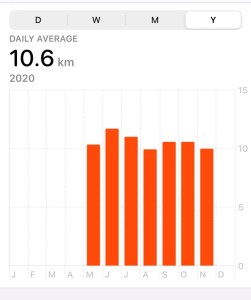
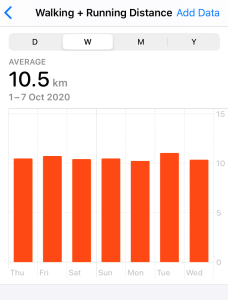
Also to show I have done the walking I include this snapshot from my phone showing my walking since May (when I got the phone).  I have been able to average more than 10k a day which way my plan:

I have really enjoyed the challenge of the pilgrimage and have firmly embedded the habit of getting up at 5am to go for a walk. I have gone through one pair of runners over the course of the last three months which is also a testament to the concrete pavements I have pounded around Box Hill South. But one of the wonderful opportunities afforded to me as I walked was time to reflect and pray. I have enjoyed immensely the Joan Chittister   book on the Rule of Benedict and leave you with one final quote. I think it apt with all the complaining and whining around on so many issues – not least the Covid 19 restrictions!

If Benedictine spirituality understands anything about life at all, it understands the corrosive effects of constant complaining. Complaining is the acid that shrivels our own souls and the soul of the community around us as well. Complaining is what shapes our mental set. Feelings, psychology tells us, do not affect thoughts. Thoughts affect feelings. What we allow ourselves to think is what we are really allowing ourselves to feel. When we learn how to correct out thoughts processes, then we learn not only how to stabilise our own emotions but how to change the environment around us at the same time. What we see as negative we make negative and feel negative about. What we are willing to think about in a positive way becomes positive.

Complaining, in other words, undermines the hope of a community and smothers possibility in a group. The whinner, the constant critic, the armchair complainer make an office, a family, a department, a community a polluted place to be. What we accept wholeheartedly that fails, we can always correct. What we condemn to failure before we have ever really tried to accept it, is not corrected; it is doomed to an untimely and, more than likely, an unnecessary death.

Benedictine spirituality tells us to open our hearts and our minds to let grace come in from unlikely places, without preplanning and prejudgments. “When there is no desire,” the Tao Te Ching instructs, “all things are at peace.”

So this is the last post for the time being. Thank you once again to all who have followed my 95 day pilgrimage and blessings to you all.

Day 86 of Pilgrimage – Home is in sight!

Friday 13 November 2020

In one way it is sad to think that my virtual pilgrimage will finish in nine days. I arrive back at St Paul’s Cathedral next Friday and back to my home parish of St Peter’s on the Feast of Christ the King and I will have completed 945k round trip.

Due to the generosity of so many the funds raised during the pilgrimage have just passed $3900 and I hope to be able to report next week that we have raised $4000 – a fantastic effort of which I am so proud and humbled at the same time.

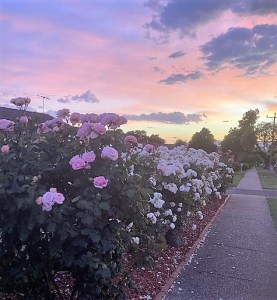
The days are getting warmer and the flowers are in bloom. Here are some recent shots taken in the last week:

While I have been continuing my reading of the Rule of Benedict I have also been reading a fascinating book – The Astonished Heart: Reclaiming the Good News from the Lost-and-found of Church History by Robert Capon.

I have been thinking a lot about the church post-COVID. I have been asking myself whether this year will just be a blip and normal business will resume once a vaccine has been developed, or whether this year is the start of a major reformation in the way WE do church and BE church. Robert’s book is astounding and is a sign of hope that the church will go on. Robert writes:

Because the church is not a club; it is a divine Mystery – the body of him who fills all in all and who, when he is lifted up, draws all to himself. We are in a dance of desire over which we have no final power to throw a wet blanket. The thirst of the astonished heart lies at the root of all thirst, however trivial, and it is the thirsty, therefore – and the hungry, the last, the lost, the least, the little, and the dead – who are the sacraments of the church’s hope. Only fools, of course, willingly embrace those conditions. But the divine Fool who died and rose needs only one of them – himself – to bring the dance to its wild conclusion. Even if the rest of us are tripping over our feet to the end of time – even if we spend every one of our days trying to wallflower our way through the corporate church, the mega-church, the Christendom church, the country-club church, or the self-improvement church – even if we never get the dance of desire right, God never gets it wrong.

Next Friday’s blog post will be the last of the Friday posts. I hope to be able to share one final meeting with the Dean of Melbourne next week and then one last post on Sunday 22 November as I officially finish the pilgrimage where it all started – St Peter’s Anglican Church, Box Hill.


Day 79 of Pilgrimage – On the way back to Melbourne

Friday 6 November 2020

790k completed and two weeks to go and I will be back in Melbourne. I am planning to go back to St Paul’s Cathedral for one final catch up with the Dean and chat about what I have gained across the course of this pilgrimage. The pilgrimage will end officially on Sunday 22 November – the Feast of Christ the King.

I am happy to report that the total of funds raised so far has just passed $3600 – a fantastic effort and I am humbled by people’s generosity. 

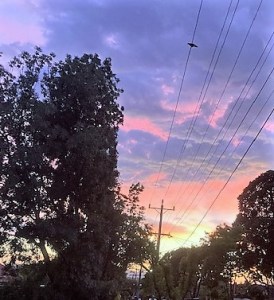
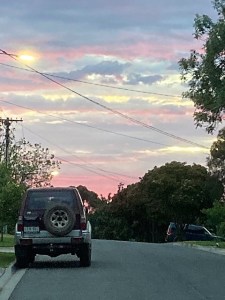
The mornings when I walk have been lovely over the last week. There have been some glorious sunrises –

I have also noticed that people have been doing a lot of work in their gardens and on front verges – 

More reflections from the ‘Rule of Benedict’:

The idea that the spiritual life is only for the strong, for those who don’t need it anyway, is completely dispelled in the Rule of Benedict. Here spiritual athletes need not apply. Monasticism is for human beings only. The abbot and prioress are told quite clearly that they are to see themselves as physicians and shepherds tending the weak and carrying the lost, not as drill sergeants, not as impresarios. What we have in monasteries and parishes and all fine social movements and devoted rectories and most families are just people, simple people who never meet their own ideals and often, for want of confidence and the energy that continuing commitment takes, abandon them completely. Then, our role, the Rule of Benedict insists, is simply to try to soothe what hurts them, heal what weakens them, lift what burdens them and wait. The spiritual life is a process, not an event. It takes time and love and help and care. it takes our patient presence. Just like everything else.

One of the things I have also been reflecting upon has been the resurgence of the pandemic in Europe, especially in the UK. The Church of England is calling for a month of prayer as their country goes back into lockdown and they have provided some resources for this prayer time:

Church of England prayers

May God continue to bless us all.

Day 72 of Pilgrimage – St Paul’s Cathedral, Sale, Victoria

Friday 30 October 2020

I am almost at the doors of St Paul’s Cathedral in the beautiful city of Sale.

https://www.stpaulssale.org.au/

It has taken 72 days – 720k – and I arranged a zoom meeting recorded earlier in the week where I received a fantastic welcome from the Dean of St Paul’s Cathedral, the Very Reverend Susanna Pain. Our conversation went so well and was so interesting that I forgot at the time to ask what I could be praying for as I visited the Cathedral. In an email latter she wrote:

Please pray for smooth transitions as restrictions ease; and deep connections with those feeling isolated, and still isolating. For our synod coming up in a few weeks on zoom, and ordination at the end of the month, with who knows how many people.

Here is our zoom conversation:

The quiet day that the Dean mentions is on this coming Sunday and the details are here:

quiet 1 November 2020

The weather is again fantastic early in the morning when I do the bulk of my 10k’s – here is another glorious sunrise – not as spectacular as the last one posted but nevertheless beautiful – peaceful and quiet.

Thanks to the generosity of so many, donations have now just passed the $3000 mark and I am very thankful for all your kind support. More reflections from the Rule of Benedict:

Prayer in the Benedictine tradition, then, is not an exercise done for the sake of quantity or penance or the garnering of spiritual merit. Benedictine prayer is not an excursion into a prayer-wheel spirituality where more is better and recitation is more important than meaning. Prayer, in the spirit of these chapters, if we ‘sing praise wisely,’ or well, or truly, becomes a furnace in which every act of our lives is submitted to the heat and purifying process of the smelter’s fire so that our minds and our hearts, our ideas and our lives, come to be in sync, so that we are what we say we are, so that the prayers that pass our lips change our lives, so that God’s presences becomes palpable to us. Prayer brings us to burn off the dross of what clings to our souls like mildew and sets us free for deeper, richer, truer lives in which we become what we seek.

I am reminded of the motto of my High-School, Wavell State High, in Brisbane, which is Esse Quam Videri which means: To be, rather than to seem to be. How to be authentic and faithful in trying circumstances has been a question floating around in my head as I walk. To be people of deep real hope is my prayer for us all this week.

Day 65 of Pilgrimage – a week to go to Sale

Friday 23 October 2020

By the end of today I will have walked 650k and will arrive ‘virtually’ in Sale, Victoria at St Paul’s Cathedral next Friday. On Tuesday this week (20 October) I passed the 2/3 mark in the pilgrimage – it is amazing to think that it will all be over on Sunday 22 November!

If you read last week’s blog – you will have seen a beautiful sunrise over the Dandenong Range. This week the weather hasn’t been as kind and one morning I walked in particularly heavy rain:

However, the rain cleared by the time I got to the high point in my route and I took this lovely shot:

Just to keep things above board – I post a screen shot of my last week’s walking – the average is still above 10k a day!

Last Sunday we had stage four restrictions eased a little and barbers were allowed to open and I took the chance to get my first haircut in SIX months – here are the before and after shots:

I want to share from another book I have been reading and pondering in this pilgrimage – it’s by Samuel Wells – Vicar of St Martin-in-the-Fields, London, UK and is titled “Face to Face: Meeting Christ in friend and stranger”

Samuel writes the following:

Hands are given to those in ministry to discover three things: when to touch, how to touch, and when not to touch. In the story of the transfiguration in Matthew’s account, we read, “But Jesus came and touched them, saying, ‘Get up and do not be afraid.” (17.7) In other words, Jesus does four things. He comes to them. He touches them; he touches each of the disciples before he said anything. He encourages them to get up while they’re still frightened. And then finally he says: “Do not be afraid.” This fourfold action of coming, touching, raising and empowering is a microcosm of the whole gospel story. Jesus first comes to us in his incarnation. Jesus then touches us in his teaching and healing ministry. And then in his cross and resurrection and in the coming of his Spirit at Pentecost Jesus raises us up and clothes us with power and gives us reason not to be afraid. The whole gospel is in this single verse. (pp xxv and xxvi)

I have lost track of the number of times I have read that passage and the many times I have preached on the feast of the Transfiguration – and this was for me a fresh and empowering interpretation of the text. Much to ponder as I continue to walk.


Day 58 of Pilgrimage – two weeks to go to get to Sale

Friday 16 October 2020

The weather is certainly changing. The views at particular points in my daily route are spectacular. Here is the dawn breaking over the Dandenong range last Wednesday (14 October 2020)

By the end of today I will have walked 580k and will arrive ‘virtually’ in Sale, God willing, on Friday 30 October. I am looking forward to catching up with the Dean of the Cathedral of the Diocese of Gippsland soon!

Thanks to the generosity of so many the pilgrimage account has over $2500. This is a fantastic effort and I thought you might like to see where the money is going. The Whitehorse Churches Care group is a partnership between many of the churches (including the Anglican Parish of Box Hill) in the Whitehorse council area to provide much needed love and care and compassion and support to those in need in our area.

Here is the link to our website: http://whitehorsechurchescare.org.au/

Walking early in the day in the peace and beauty and quiet of Box Hill gives one plenty of think to reflect. Here is more material that has been bouncing around in my head and heart. From The Rule of Benedict, chapters 10 and 11 – comments by Joan Chittister,

… the message of Benedictine spirituality is a consistent one: live life normally, live life thoughtfully, live life profoundly, live life well. Never neglect and never exaggerate. It is a lesson that a world full of cults and fads and workaholics and short courses in difficult subjects needs dearly to learn.

Prayer is the development of an attitude of mind that is concentrated and contemplative. For Benedict, therefore, the Sunday Office is a centrepiece that is fixed and solemn. The message is clear: Sunday, the weekly celebration of creation and resurrection, is always a reminder of new life, always special, always meant to take us back to the Beginning and the End, the Alpha and the Omega, the Centre of life. It is a day full of tradition and rhythm and rememberings of the simple but important concepts of existence. It is a return to basic truths that are never to be sacrificed for variety and always reinforced through repetition… the Sabbath is the moment for returning to the surety and solemnity of life, for setting our sights above the daily, for restating the basics, for giving meaning to the rest of the week so that the mundane and the immediate do not become the level of our existence.

Day 51 of Pilgrimage – 60k southeast of Wangaratta on the way to Sale

Friday 9 October 2020

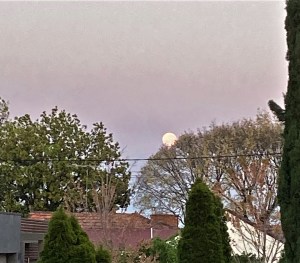
It is amazing to consider that I have walked over 500k so far on this pilgrimage and on Tuesday last (6 October) crossed the half-way point of the walk! The weather has been a bit up and down in the last week – some very soggy and cold mornings balanced by some beautifully crisp spring mornings, including lovely views of the full moon.

Here also is a shot of my last week’s walking  just to keep everything above board:

I have a while to go to get to Sale for the next Cathedral welcome, so it’s just my ponderings and reflections as I walk the well-known (by me at least by now) streets of Box Hill south each and every day. I have mentioned that for prayer in the mornings I have been reading ‘Holy women, Holy men – celebrating the saints’ – a day-by-day outline of those saints who have gone before us. It has been a delight to read about people I previously knew nothing about, for example, Richard Theodore Ely, an American economist, who lived from 1854 to 1943. We remembered his life yesterday, Thursday 8 October. Let me quote from the book –

In 1894, Ely was accused of teaching socialist principles and effort was made to remove him from his professorship at the University of Wisconsin. Ely, who rejected the extremes of both capitalism and socialism, stated in his defence, “I condemn alike that individualism that would allow the state no room for industrial activity, and that socialism which would absorb in the state the functions of the individual.” What was needed instead, he argued, was a proper and healthy balance between public and private enterprise. Ely favoured competition with regulation that would raise the moral and ethical level of economic practice.

Ely claimed that the Gospel was social rather than individualistic in nature, and he consistently called the Episcopal Church to work towards the reform of capitalism for the sake of the rights and dignity of the American worker.

O for such economists now stirring the Church in all Western nations to advocate for compassion and justice in our capitalist systems.

I have also as part of my morning prayer been reflecting upon Joan Chittister’s book: The Rule of Benedict – a spirituality for the 21st century. The last ten days have been a reflection upon some the 12 steps of humility outlined by Benedict’s rule (chapter 7) Step 4 is to endure suffering and Joan writes the following which I continue to find unsettling:

To bear bad things, evil things, well is for Benedict a mark of humility, a mark of Christian maturity. It is a dour and difficult notion for the modern Christian to accept. The goal of the twenty-first century is to cure all diseases, order all inefficiency, topple all obstacles, end all stress, and prescribe immediate panaceas. We wait for nothing and put up with little and abide less and react with fury at irritations. We are a people without patience. We do not tolerate process. We cannot stomach delay. Persist. Persevere. Endure, Benedict says. It is good for the soul to temper it. God does not come on hoofbeats of mercury through streets of gold. God is in the dregs of our lives. That’s why it takes humility to find God where God is not expected to be.

Much to ponder as I continue to walk.